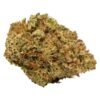
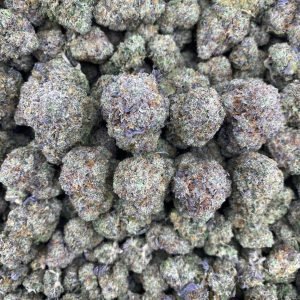
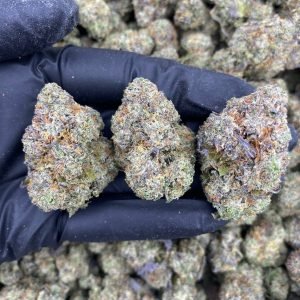
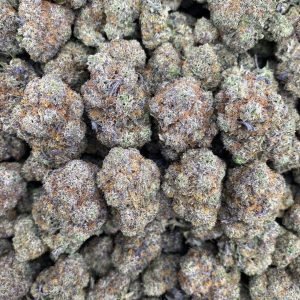
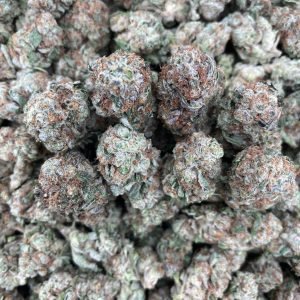
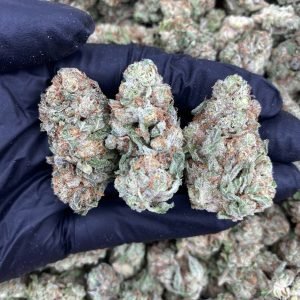
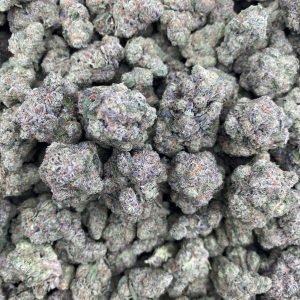
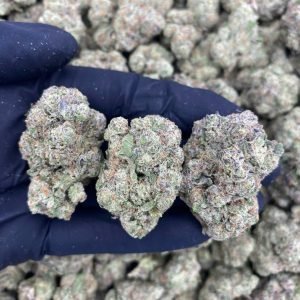
Within modern horticultural and dispensary taxonomy, the term “Connoisseur” designates both an elite standard of small-batch, terpene-forward craft cultivation and the specific flagship cultivar line Connoisseur Cookies, bred by the acclaimed boutique collective Connoisseur Genetics. Developed by crossing heavy-yielding, high-resin foundations ($\text{OG Chem} \times \text{Granddaddy Purple}$) with the highly sought-after but lower-yielding Girl Scout Cookies cutting, this chemotype was bred to overcome the structural fragility and modest yields of the original Cookies clone while intensifying its dessert-and-gas organoleptic profile.
Botanical Lineage & Genetic Architecture
-
Parental Stock: $[\text{OG Chem} \times \text{Granddaddy Purple}] \times \text{Girl Scout Cookies}$ (reversed Forum Cut pollen donor).
-
Ancestral Lineage: Integrates foundational landraces and legacy heirloom cultivars across four distinct lineages: Hindu Kush, Afghani, Chemdawg (Chem D), and Durban Poison.
-
Genetic Equilibrium: Predominantly indica hybrid (approximately $70\%\text{ indica / }30\%\text{ sativa}$ phenotypically).
-
Breeding Objective: To stabilize a cultivar expressing the rock-hard bud density and deep grape-candy aromatics of Granddaddy Purple, the industrial hydrocarbon potency of OG Chem, and the sweet, doughy resin head production of Girl Scout Cookies.
Phytochemical & Cannabinoid Profile
-
$\Delta^9$-Tetrahydrocannabinol ($\text{THC}$): Averages between 22% and 28% total potential THC by dry weight. Primarily synthesized as $\Delta^9$-tetrahydrocannabinolic acid ($\text{THCA}$) inside the capitate-stalked glandular trichomes, requiring heat-driven decarboxylation to become pharmacologically active.
-
Cannabidiol ($\text{CBD}$): Minimal ($\le 0.1\%\text{–}0.4\%$), characterizing the cultivar as a potent Type I chemotype ($\text{high THC / low CBD}$).
-
Minor Phytocannabinoid Spectrum: Demonstrates elevated secondary cannabinoid concentrations, including cannabigerol/cannabigerolic acid ($\text{CBG/CBGA}$, $1.0\%\text{–}2.2\%$), cannabichromene ($\text{CBC}$, $0.3\%\text{–}0.6\%$), and trace amounts of cannabinol ($\text{CBN}$, indicating slow degradation of glandular resin during extended curing).
Terpenoid Spectrum & Olfactory Character
-
Total Terpene Content: Consistently achieves elevated terpene fractions ($2.5\%\text{ to }>4.0\%$ total dry weight), characteristic of true craft-level selections:
-
$\beta$-Caryophyllene: Primary sesquiterpene; contributes warm, cracked-black-pepper spice and functions as a selective exogenous agonist of peripheral $\text{CB}_2$ receptors.
-
$\beta$-Myrcene: Primary monoterpene; delivers rich, damp-earth and herbal undertones while altering the permeability of cell barriers to facilitate rapid central uptake of cannabinoids.
-
Linalool: Floral, lavender-like monoterpene derived from the GDP lineage; modulates voltage-gated channels and provides synergistic anti-hyperalgesic and anxiolytic properties.
-
$d$-Limonene: Cyclic monoterpene adding a bright citrus fuel punch and modulating central dopamine/serotonin tone.
-
$\alpha$-Humulene: Contributes hoppy earthiness and works alongside caryophyllene to suppress acute inflammatory responses.
-
Organoleptic Profile: Distinctive layers of sweet dark grape, vanilla dough, and roasted sugar on the inhale, breaking down into an acrid kerosene, diesel, and earthy skunk finish upon exhalation.
Pharmacodynamics & Endocannabinoid Mechanisms
-
Central & Peripheral Receptor Modulation: Decarboxylated $\Delta^9\text{-THC}$ binds as a partial agonist to presynaptic cannabinoid type 1 ($\text{CB}_1$) and type 2 ($\text{CB}_2$) receptors.
-
Retrograde Neurotransmitter Suppression: Activation of $G_i/G_o$ protein-coupled $\text{CB}_1$ receptors suppresses presynaptic calcium influx and stimulates potassium conductance, inhibiting the exocytotic release of excitatory transmitters (glutamate, acetylcholine, substance P) within dorsal horn nociceptive and limbic pathways.
-
The Entourage Cascade: The co-presence of substantial linalool and myrcene fractions exerts an inhibitory effect on central nervous system hyperarousal, attenuating the tachycardic or anxiogenic edge often produced by high-dose $\text{THC}$ monotherapy while magnifying physical neuromuscular sedation.
Phenotypic Morphology & Cultivation Metrics
-
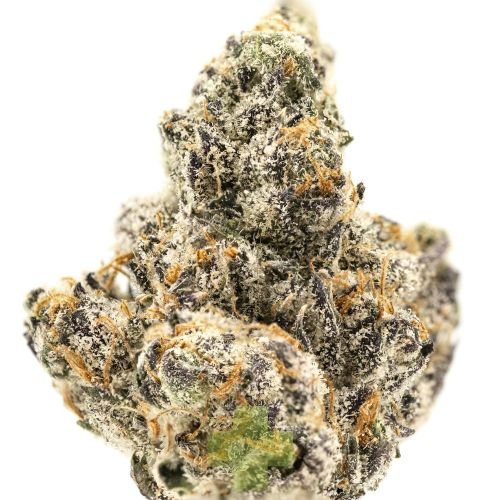
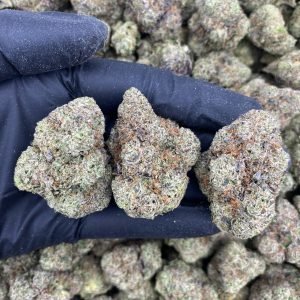
Floral Architecture: Produces dense, golf-ball-sized calyx clusters with a high calyx-to-leaf ratio. Under cooler night-cycle temperatures late in the flowering cycle, the calyxes express rich dark purple and burgundy anthocyanin pigments inherited from the Granddaddy Purple parentage.
-
Trichome Coverage: Exceptional coverage of glandular trichomes with large, bulbous secretory heads that mature from clear to milky-opaque and deep amber, making it an ideal candidate for solventless ice-water hash and live rosin extraction.
-
Flowering Cycle & Photoperiod: Requires approximately 63 to 70 days (9 to 10 weeks) of indoor flowering to achieve full resin maturity. Exhibits robust branch strength capable of supporting dense terminal colas without excessive staking, yielding between $400\text{–}500\text{ g/m}^2$ under optimized environmental controls.
Clinical Applications & Symptom Management
-
Severe Musculoskeletal Pain & Spasticity: Provides potent analgesia and central muscle relaxation, useful in managing fibromyalgia, lumbar radiculopathy, and nocturnal muscle cramps.
-
Refractory Insomnia: High concentrations of myrcene combined with high-potency $\text{THC}$ markedly reduce sleep-onset latency and inhibit frequent nocturnal awakenings.
-
Anorexia & Wasting Syndromes: Strongly stimulates hypothalamic orexigenic pathways, driving appetite restoration in patients undergoing cytotoxic chemotherapy or managing chronic cachexia.
-
Post-Traumatic Stress & Severe Hyperarousal: Dampens retrieval of adverse associative fear memories and reduces autonomic nervous system hyperactivity.
Safety Considerations, Side Effects, & Contraindications
-
Adverse Effects: Marked xerostomia (“dry mouth”), conjunctival vascular injection, transient postural hypotension, motor coordination deficits, and somnolence.
-
High Potency Precautions: Due to $\text{THC}$ concentrations regularly exceeding 25%, rapid titration or excessive dosing can precipitate transient depersonalization, acute paranoia, or panic responses in cannabinoid-naive patients.
-
Central Depressant Synergy: Concurrent use with sedative-hypnotics, benzodiazepines, or alcohol causes additive central nervous system depression and profound impairment of cognitive and psychomotor function.
-
Contraindications: Contraindicated in patients with active unstable ischemic heart disease, a personal or family history of schizophrenia or bipolar disorder, and during pregnancy or breastfeeding.