Originally selected in the early 2010s by Northern California breeders exclusively for recording artist Wiz Khalifa, Khalifa Kush was developed through targeted phenotypic isolation to create an elevated, daytime-functional iteration of the traditional “couch-locking” OG Kush profile. While the exact maternal and paternal lines remain proprietary, extensive phytochemical and morphological analysis confirms its foundation within the ancestral South Florida/Southern California Chemdawg and Pakistani Kush lineage. The resulting chemotype features dense floral architecture, pronounced glandular trichome density, and a terpene profile engineered for high alertness and cerebral clarity.
Botanical Lineage & Genetic Architecture
-
Parental Heritage: A specialized phenotype derived from an OG Kush backcross ($\text{Chemdawg} \times \text{Lemon Thai} \times \text{Pakistani Hindu Kush}$).
-
Genetic Classification: Balanced hybrid ($50/50$ to slightly indica-dominant $60/40$, depending on clonal line).
-
Breeding Objective: Designed to retain the distinct terpene complexity, gas/diesel aroma, and potency of an authentic OG Kush while eliminating the heavy secondary somnolence common to older indica chemotypes.
Phytochemical & Cannabinoid Profile
-
$\Delta^9$-Tetrahydrocannabinol ($\text{THC}$): Consistently tests between 24% and 29% total potential THC by dry weight. Biosynthesized within secretory head cells as $\Delta^9$-tetrahydrocannabinolic acid ($\text{THCA}$), it requires thermal exposure (decarboxylation) to convert into bioactive $\Delta^9\text{-THC}$.
-
Cannabidiol ($\text{CBD}$): Typically low ($\le 0.1\%\text{–}0.5\%$), categorizing the cultivar as a pure Type I chemotype ($\text{high THC / low CBD}$).
-
Minor Phytocannabinoid Profile: Frequently expresses notable concentrations of cannabigerolic acid/cannabigerol ($\text{CBGA/CBG}$, $0.8\%\text{–}1.8\%$), cannabichromene ($\text{CBC}$, $0.2\%\text{–}0.4\%$), and trace amounts of tetrahydrocannabivarin ($\text{THCV}$, $<0.3\%$).
Terpenoid Spectrum & Olfactory Character
-
Dominant Terpene Fraction:
-
$\beta$-Caryophyllene: Primary sesquiterpene; delivers sharp, cracked-black-pepper spice notes while serving as a functional, non-psychoactive dietary cannabinoid that directly engages peripheral $\text{CB}_2$ receptors.
-
$d$-Limonene: Abundant cyclic monoterpene providing bright, sour lemon zest top-notes; facilitates transdermal/transmucosal absorption and modulates central monoaminergic tone to promote mood elevation.
-
$\alpha$-Pinene & $\beta$-Pinene: Monoterpenes providing crisp, woodsy evergreen aromatics; acts as a reversible acetylcholinesterase inhibitor, mitigating common $\text{THC}$-induced short-term memory attenuation and mental fog.
-
$\beta$-Myrcene: Present in moderate concentrations; contributes musky, herbal undertones and promotes somatic muscle relaxation without overwhelming sedation.
-
Organoleptic Quality: Pronounced sour lemon and fuel/kerosene funk upon initial handling, breaking down into pungent pine forest, damp earth, and peppery diesel upon combustion or vaporization.
Pharmacodynamics & Endocannabinoid Mechanisms
-
Receptor Agonism: Thermally converted $\Delta^9\text{-THC}$ acts as a partial agonist at presynaptic cannabinoid type 1 ($\text{CB}_1$) receptors in the central nervous system and type 2 ($\text{CB}_2$) receptors primarily situated on peripheral immune tissues.
-
Synaptic Modulation: Activation of $G_i/G_o$-protein-coupled $\text{CB}_1$ receptors inhibits presynaptic voltage-gated $\text{Ca}^{2+}$ influx and facilitates inward $\text{K}^+$ conductance, suppressing the retrograde exocytosis of excitatory neurotransmitters (such as glutamate) while modulating dopamine release across mesolimbic reward pathways.
-
Synergistic Modulation: The co-presence of elevated limonene and pinene counteracts the heavy, sedating tone typically imposed by myrcene-dominant indica chemotypes, creating a biphasic clinical effect characterized by rapid cerebral stimulation and heightened sensory perception followed by calm somatic muscular relaxation.
Phenotypic Morphology & Cultivation Metrics
-
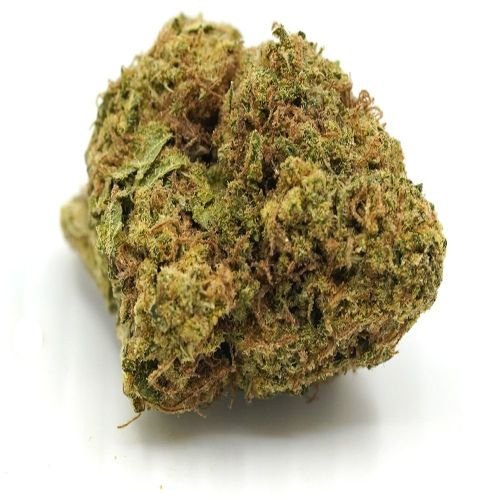
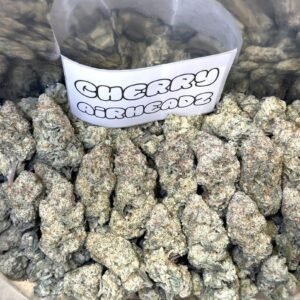
Vegetative & Floral Architecture: Exhibits characteristic OG Kush growth architecture with moderate internodal elongation and lateral branching that benefits from trellis netting ($\text{ScrOG}$) support. Produces dense, compact, pinecone-shaped calyx clusters adorned with vivid forest-green bracts and thin, amber-to-copper pistillate hairs.
-
Trichome Morphology: Floral surfaces and adjacent sugar leaves are densely frosted with large, capitate-stalked glandular trichomes exhibiting high resin viscosity and amber secretory heads at peak harvest ripeness.
-
Flowering Cycle & Performance: Indoor flowering completes in approximately 60 to 65 days (8.5 to 9.5 weeks). Shows high responsiveness to balanced high-intensity discharge or full-spectrum LED lighting and demanding nutrient regimens, yielding moderate-to-high biomass ($450\text{–}550\text{ g/m}^2$).
Clinical Applications & Symptom Management
-
Mood Disorders & Chronic Stress: Rapidly downregulates hyperactive amygdalar stress signaling, offering acute relief for chronic generalized anxiety, occupational burn-out, and treatment-resistant dysthymia.
-
Musculoskeletal Pain & Inflammation: $\beta$-Caryophyllene-mediated $\text{CB}_2$ receptor activation synergizes with central $\text{CB}_1$ analgesia to modulate nociceptive threshold signaling in arthritis, fibromyalgia, and chronic low back pain.
-
Appetite Stimulation & Nausea Suppression: Potently stimulates orexigenic pathways via hypothalamic ghrelin receptor interactions and depresses the emetic reflex in the medullary area postrema.
-
Daytime Fatigue & Anhedonia: Unlike heavily sedating Kush landraces, the pinene/limonene composition provides daytime motivation and functional relief without inducing daytime somnolence.
Safety Considerations, Side Effects, & Contraindications
-
Common Side Effects: Marked xerostomia (“dry mouth”), conjunctival vascular dilation (“red eyes”), transient sinus tachycardia, and mild dizziness.
-
Psychological Vulnerability & High Potency Hazards: Due to total $\text{THC}$ concentrations exceeding 25%, rapid ingestion can precipitate acute transient paranoia, racing thoughts, or panic reactions in cannabinoid-naive individuals or patients vulnerable to affective psychosis.
-
Cardiovascular Stress: Induces peripheral vasodilation with reflex tachycardia; exercise clinical discretion in patients with unstable ischemic heart disease or uncontrolled hypertension.
-
Psychomotor Impairment: Operating heavy machinery, motor vehicles, or performing tasks requiring high vigilance under acute intoxication is strictly contraindicated.